Gathering everything politicians say
I am building a place that keeps everything a politician has said, voted and posted, with the date and the source of each word, so that positions can be followed over the years, contradictions found and quotes checked. It starts with France. Here is what exists today.
Politicians speak every day, in Parliament, on the radio, at rallies, on X, and very little of it can be found again a year later. The debates are on the Parliament's site and the votes on another, the radio interview is taken off the replay after a few weeks, the tweet was deleted the next morning, and what remains is what the press chose to quote.
I want all of it in one place. Everything a politician has said, voted and posted over the last twenty years, kept as it was said, with the date and the source next to each word. With that in hand you can follow one person on one subject across the years and watch the position move. You can guess what they will say when the subject comes back, or how they will vote next week. You can find the contradictions, the vote against a text praised in a speech, the tweet deleted the morning after. And when a quote circulates without a source, or when someone claims they never said something, you can go and look at the original. I do not know a better way to deal with fake news.
I started with France because of the presidential election of 2027, and because the French Parliament publishes the full text of its debates, which makes it a good place to begin. The question is the same in every country though. A German minister or a Spanish deputy has said as many things that nobody kept, and once the sources are found the same tools will do the same work for them. The tools on this site are the first pieces.
What they said
Recherche politique is a page with two fields, who and what. Behind it is a database of about 7.8 million texts by some 4,700 people, deputies, senators, ministers and members of the European Parliament, from 1959 to today.
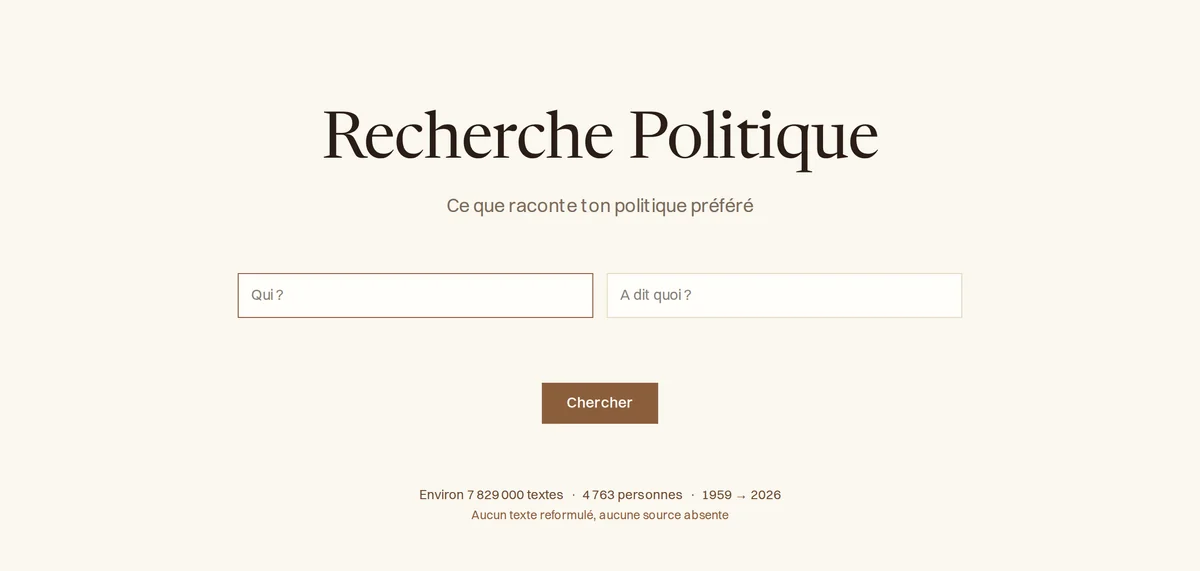
All of it comes from public sources. There are the verbatim records of the National Assembly and the Senate, every word spoken in the chamber and in committee where it is published, the written questions to the government and their answers, the amendments with the text they propose and the reasons given for it, the speeches collected by Vie-publique, the state archive of political speech, since 1959, the declarations of interests filed with the transparency authority, and since this summer the morning interviews of a public radio station, transcribed. Each text keeps the address it was taken from, the original file and the date it was collected, and none of it is rewritten. When the source does not say for certain who is speaking, the name stays as printed and is linked to nobody.
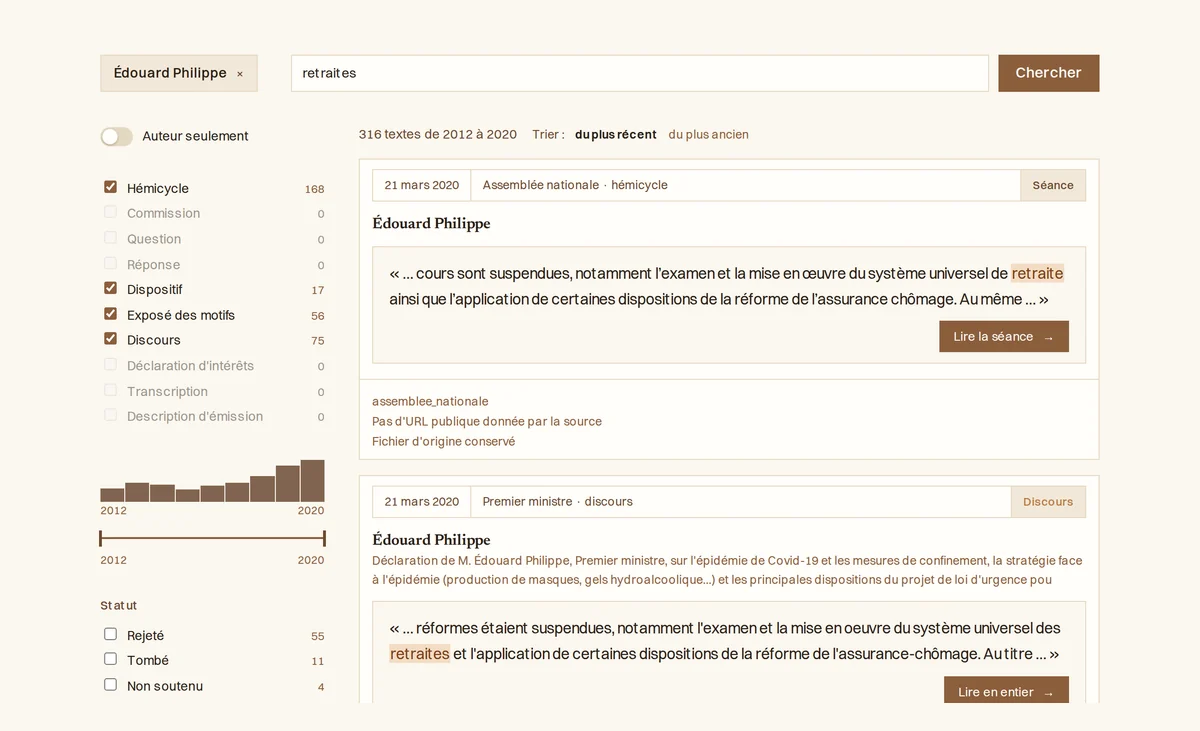
Type a name and a word, and you get every passage where that person used that word, most recent first, with the word highlighted in its sentence and the source under each card. The filters on the left say where it was said, in the chamber, in an amendment, in a speech, and the small histogram shows in which years.
Type a name alone and you get the person's page, their career as Wikidata records it, how much they spoke in the chamber each year and how many texts they signed, and a field to search inside what they said.
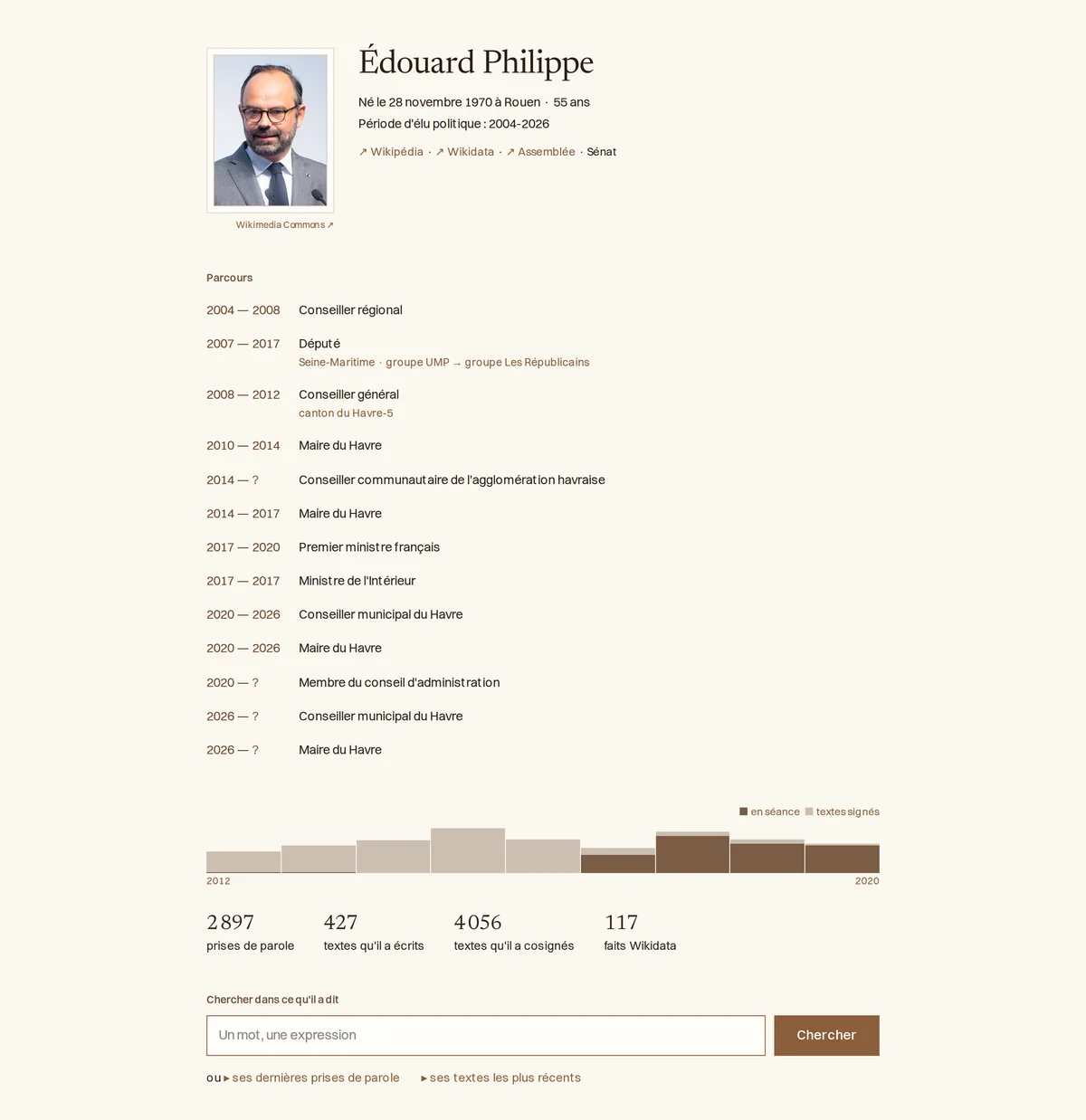
The page is in French, like the texts.
How they voted
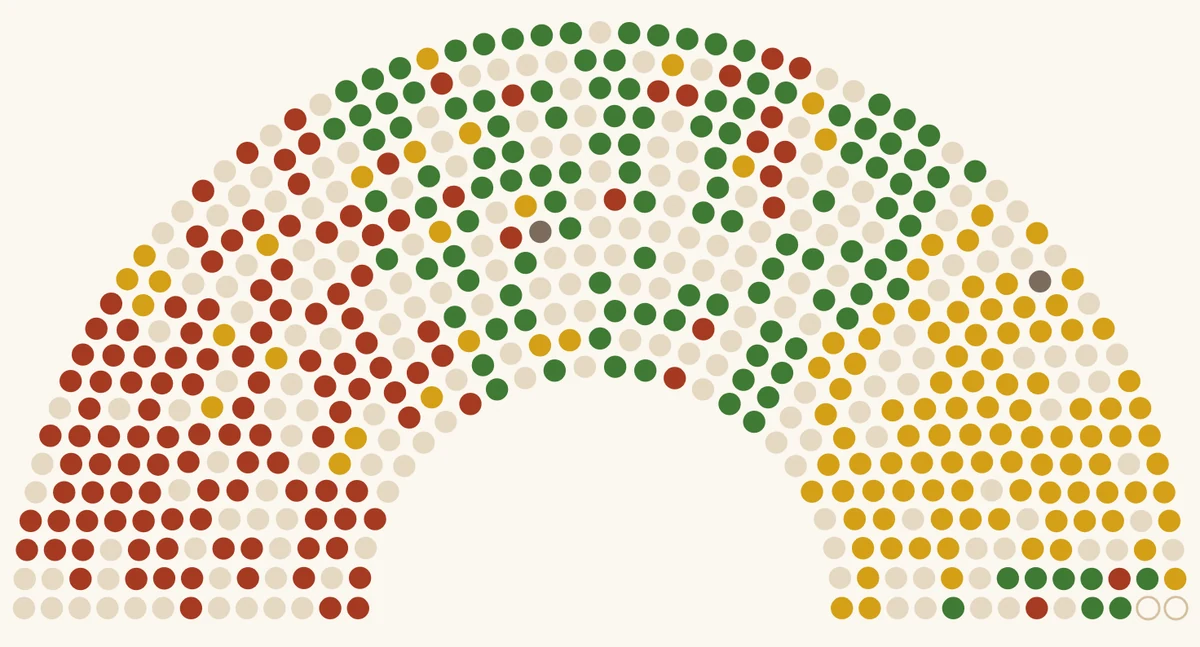
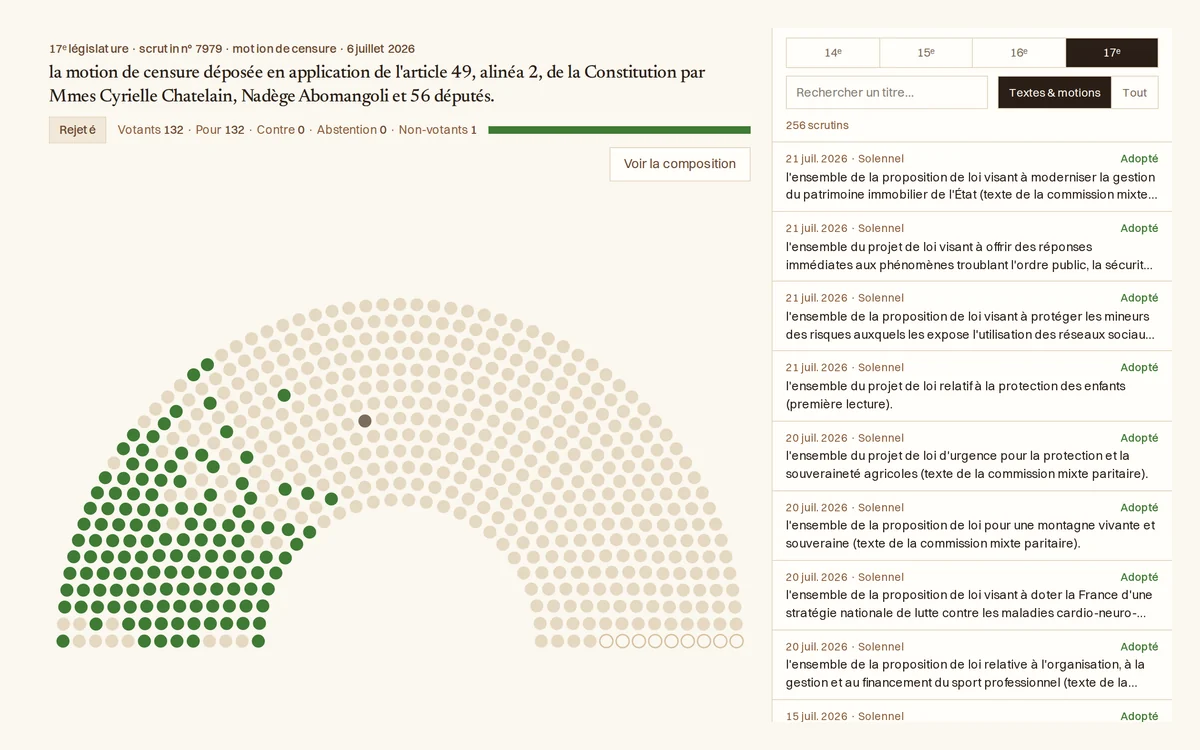
Votes du Parlement shows every public vote of the National Assembly since 2012 and of the Senate since 2006. Pick a vote and the hemicycle colours itself, one dot per seat, green for yes, red for no, yellow for abstention. You can colour the same seats by political group instead, and open the page of any deputy or senator to see all their votes, including the ones they missed.
What they post
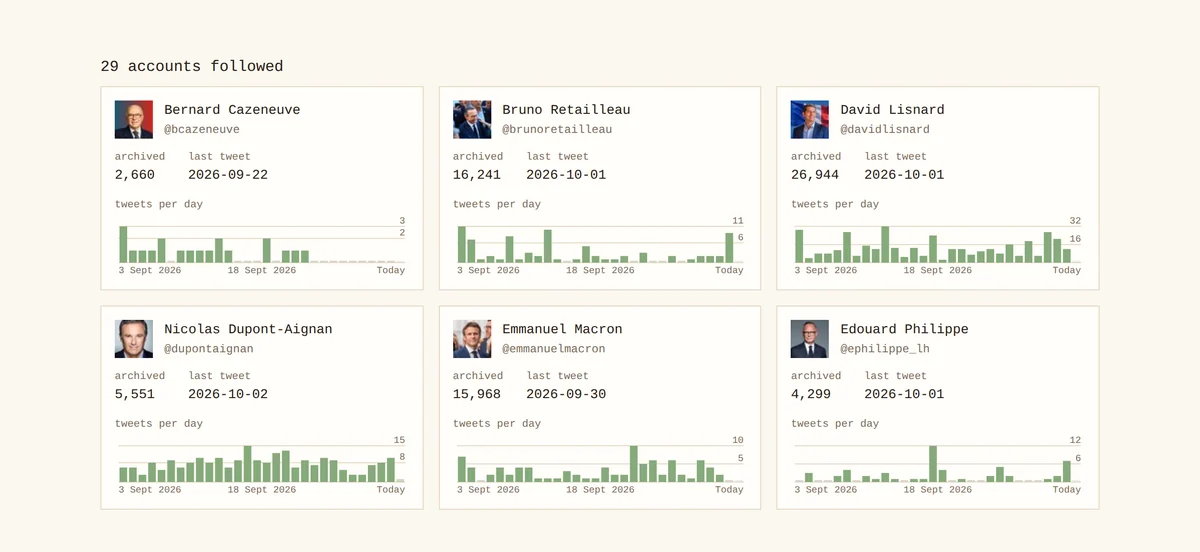
The third tool is the one that grows fastest. The Twitter Profile Analyser follows 29 accounts, the president, prime ministers past and present, the heads of the main parties, the declared and the probable candidates. It keeps every tweet they publish from now on and digs a little further back into their history every day.
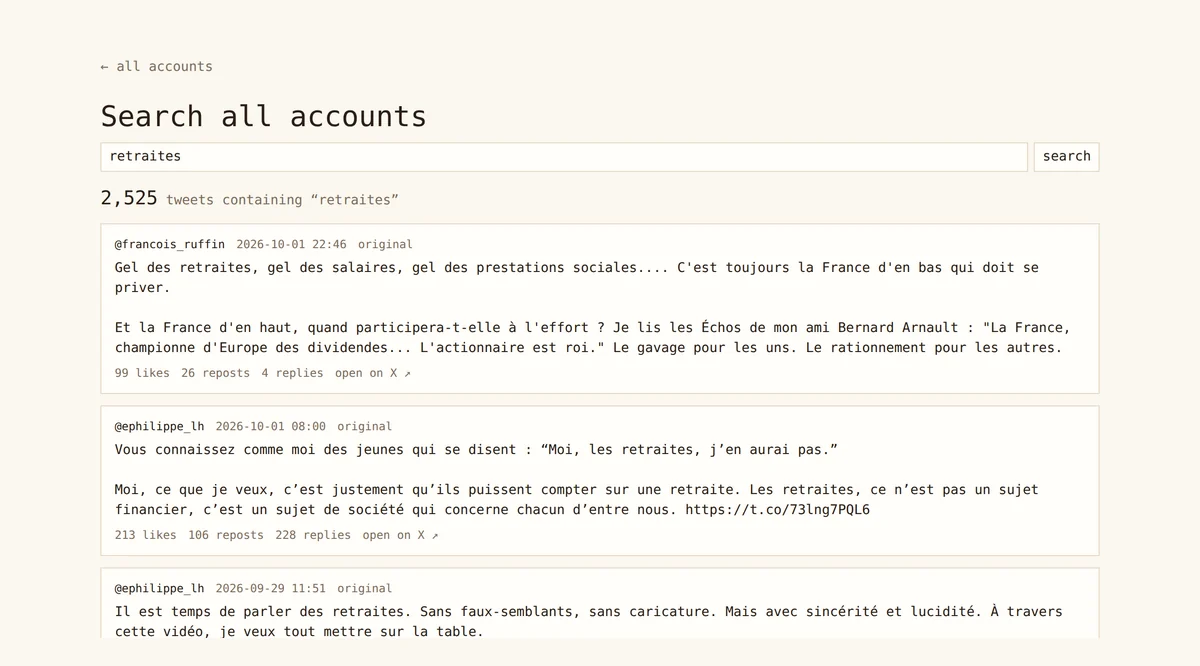
Each account has a page with its tweets, its followers over time and its activity by period. The search across all accounts at once is the part I use most. Type a word and you read, on one page, what everyone said about it, in the order they said it.
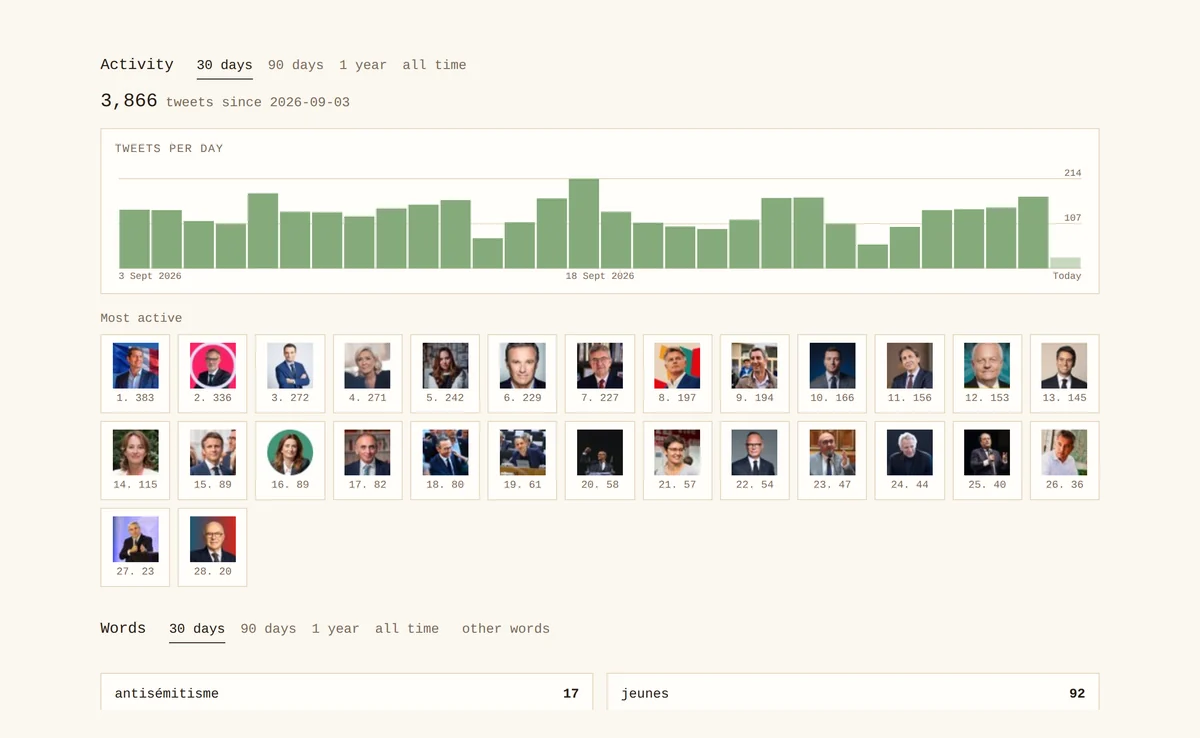
The home page adds everything up. It shows how many tweets the whole group posted each day, who was the most active, and how often four words of the campaign, drawn at random, came up over the last month or the last year.
Deleted tweets are kept. When a tweet disappears from X it stays on the page, marked as no longer on X, without a link. A programme checks every night which tweets are still online and looks in the Wayback Machine for the ones X no longer serves.
The press, on another subject for now
The German News Monitor is the oldest tool on the site and it has nothing to do with French politics. It reads the German press and the press releases of the German government and its ministries on one subject, the relations between Morocco and Germany. A programme fetches the feeds every half hour, keeps every article it has ever seen, and marks as retained the ones that mention a word from my list. You can read each collection, search it, and subscribe to it as a feed.
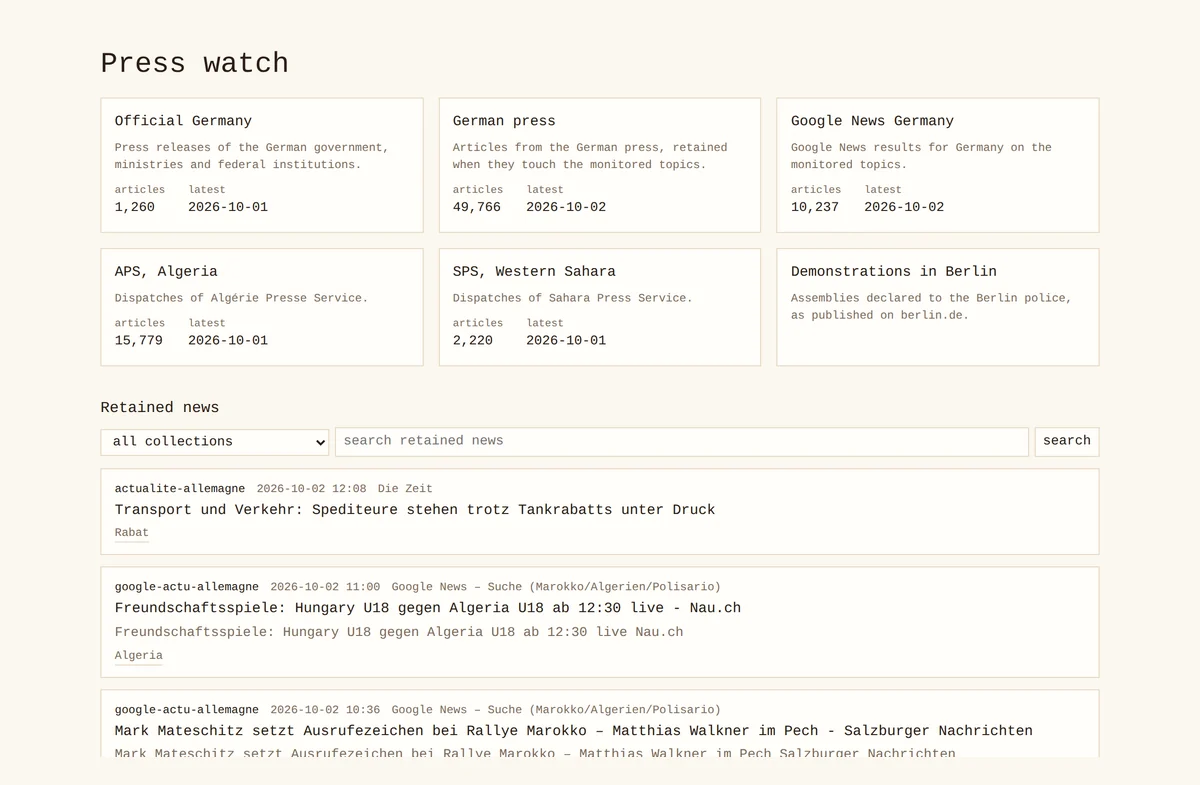
That subject will stay what it is, but the machinery will be reused. The other tools got their habits from it. Collect all the time, keep everything, delete nothing, and show what was filtered out rather than hide it. Pointed at the French press it becomes the next piece, because politicians answer the press and the press answers them, and one does not make much sense without the other.
Where this is going
The next piece is a chat. You ask in plain words what someone said about a subject, when they changed their mind on it, or whether they ever said a sentence that is going around, and an AI answers from the archive and from nothing else. Every sentence of the answer carries its source, a link to the passage, the vote or the tweet it was taken from, with the date, so you can open it and read the whole thing. If you ask what a minister said about pensions, the answer lines up the speech of 2019, the tweet of last week and the vote in between, each with its link. If a screenshot of a quote is going around, you paste it and the answer gives the passage it comes from, or says that nothing in the archive matches.